
본문
How to Tame a Blue Macaw and Red Macaw
Macaws generally choose a partner and spend a lot of time together, sharing meals, grooming each other and caring for their young. Unfortunately, these majestic bird species are on the brink of disappearing.
Humans' destruction of habitats, the cage bird trade and poaching are all major threats to this beautiful species.
Great Green glaucous macaw
The great green hyacinth macaw parrots for sale (Ara ambiguus) is the largest parrot in Central America and one of the most striking birds in the canopy of the rainforest. Its vibrant green plumage is complemented by the red of its forehead and blue on its lower back, rump and tail feathers. The long, pointed wings and tail let it easily move through the forest canopy. Its beak is large and strong, adapted for breaking open seeds and nuts. The great green Macaw is a frugivore and, therefore is a key player in maintaining healthy rainforest ecologies. Its seed dispersal helps species of trees such as the maiz-based tree Dipteryxoleifera grow, providing food to other species of animals.
 The majestic birds are typically often seen in small groups and spend most of their time in the canopy of the forest searching for nuts, fruits, and seeds. Nests are typically found in hollow tree cavities that are lined with branches or grass. Females lay two to three eggs that she will incubate for a period of 26-28 days. The male helps feed the chicks once they hatch.
Captive great-green macaws make excellent companion pets. They are intelligent, playful birds. However, it is crucial to keep in mind that these birds require plenty of space, attention and patience to thrive. They are susceptible to biting and could be destructive if bored. They are also prone to certain health problems, such as proventricular dilatation or macaw wasting.
As with many other tropical species Great green macaws, too, are declining. Their habitat is being degraded by mining, logging and agriculture as well as cattle ranching. Their numbers are also being impacted by illegal trade in wildlife and hunting for food.
 Protecting the habitat of these amazing creatures is the only way to ensure their survival. By creating corridors between protected zones, these animals will be able move freely and have access to a variety of food sources. In the end, protecting the natural habitat of these beautiful birds will help to save other species threatened by extinction that share their homes including the Scarlet Macaw and Yellow-naped Amazon.
Blue and Gold Macaw
This beautiful bird is one of most sought-after parrots kept in captivity all over the world. It is smart, affectionate, and very active. It requires a lot of interaction and training, but can be a great pet if properly trained. Macaws can be aggressive if not properly trained or given clearly defined boundaries. This is why it is crucial to find an experienced trainer who understands how to manage large birds and teach them tricks. Dave and Jamieleigh from BirdTricks have created a great video that demonstrates how to hand control the Blue and Gold Macaw. They share some tricks, tips and methods that can aid anyone in training their macaws to be friendly and fun to play with. Watch their video here.
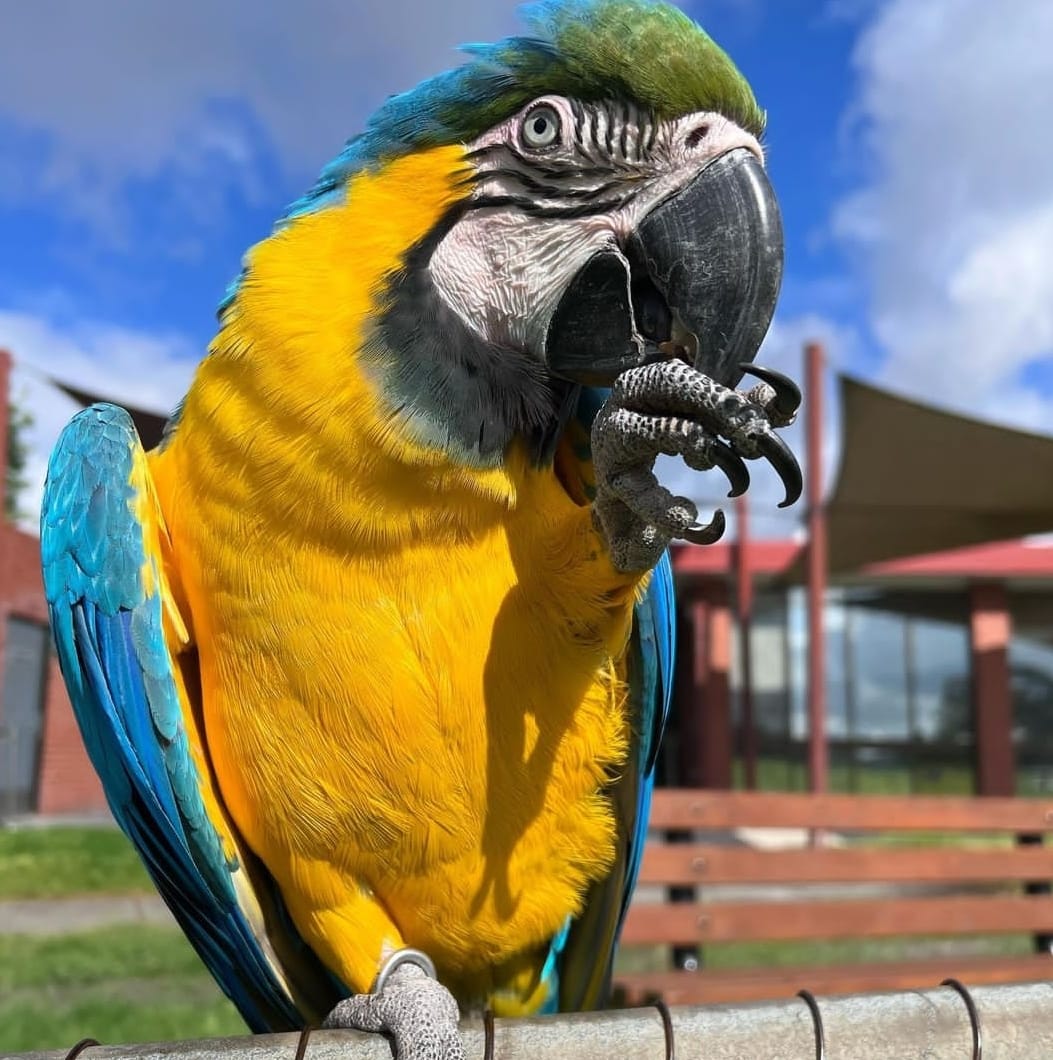
A parrot in the family, the blue and gold macaws are neotropical birds that are native to forest (especially in varzea areas) and woodland and savannah habitats of tropical Central America and South America as well as Trinidad and Tobago in the Caribbean. They have a mostly blue dorsum and tail feathers with accents of gold or yellow and gradient hues of green on the head. Their wing covers and wings are blue with green highlights. Their feet are zygodactyl with two toes facing forward and two pointing backwards. This adaptation allows them to grab branches with ease.
They are monogamous and pair for life and remain together during breeding season. They build their nests in tree cavities which they excavate with their strong beaks. They usually lay two to three eggs and then incubate them for 25 days. After hatching, leia Blue Macaw and red macaw the altricial chicks are fed through regurgitation by both parents until they are old enough to care for themselves.
Like all macaws, they're intelligent birds that convey many different emotions using a variety of vocalizations. They also exhibit a variety of courtship behaviors, including making their heads cocked, flirting by raising the wings and blushing. They can also express their emotions by shaking their tail feathers and bowing, prancing, and bouncing.
They can also be playful and they are fond of chewing toys. As such, it is recommended that pet owners provide plenty of bird-safe and durable toys that can hold up to their strong jaw muscles. This will help keep your teeth healthy and prevent them from developing excessive plaque and tartar.
Red-shouldered Macaw
Often referred to as the Hahn's Macaw, this small bird is among the most intelligent macaw species available. It is a great speaker and can learn many tricks. It is also a lot more tranquil than other macaws. This makes it a good option for those who are worried about the sound of a noisy bird. It is nippy as a baby but usually grows out of it and becomes very playful as an older parrot.
The bird is native to swamplands and savannahs as as tropical lowland habitats throughout Brazil, Venezuela Guyana and South-Eastern Peru. Its bright green color is perfect for camouflaging in the vegetation. It lays between two and five eggs, which it incubates for 24 days. After two months, the chicks are ready to fledge. The species is typically in pairs for life, and is often in pairs.
In its natural habitat, it forages for berries and flowers and nuts, fruits, seeds and leaves. The birds are known to eat insects too. They are also known to gather close to clay cliffs. This is thought to help them eliminate any toxins that they may have picked up while eating their usual food.
Hahn's Macaws can be prone to self-mutilation, feather plucking, and nutritional disorders. They are also prone to proventricular dilatation and enlarged beaks. A balanced diet, regular vet examinations, and appropriate cage maintenance can avoid these problems.
In captivity, the bird is extremely social and can live up to 40 to 50 years. It isn't typically available in pet stores with large sizes but it can be found at avian-specialty shops as well as from breeders of birds. It is intelligent to a high level, however it can be difficult for those who are new to training. It is a very good speaker, and can be trained to whistle or clap, as well as dance.
Hahn's Macaws are noisy and not recommended for apartments. They require a large cage with plenty of perches, a variety of large food bowls, and plenty of opportunities to exercise daily outside their cage. They are also robust chewers and require a cage that is sturdy and is well-secured.
Blue-and-yellow Macaw
The Blue-and Yellow Macaw is an enormous, beautiful tropical parrot. As with other members of hyacinth macaw parrots for sale family it is a monogamous species that pairs for life. It also has an inclination towards mimicry which makes it a wonderful companion bird.
This species is native to South America, and can be found in various habitats. Cloud forests, savannas and rainforests are all habitats that could be used. The Leia blue macaw and red macaw-and-yellow Macaw is deemed endangered by the IUCN Conservation efforts are in progress to protect this beautiful creature.
The birds can breed when they reach the age of 3 or 4 years old. They are known to pair for life, and will remain bonded until one of the partners dies. The Blue-and yellow macaw lays between two and three eggs per nest. The female incubates the eggs, while the male aggressively defends the nest. When the chicks are born, they are altricial, and they are dependent on their parents for food until they are capable of feathering themselves and feed themselves.
In the wild, Macaws are social birds and will spend their time in a swarm of parrots and Macaws. They are intelligent and can learn a variety of sounds. The Blue-and-yellow is a skilled flyer, and can be seen soaring through the forest canopy and performing other amazing aerial maneuvers.
The Blue-and-Yellow macaw keycaps is a stunning and captivating creature. This is a wonderful option for anyone looking for a pet to provide entertainment and companionship.
This beautiful, large tropical parrot is native to South America. It is monogamous and is a lifelong mate and has a strong tendency toward mimicry. It has a strong tendency to bond with humans and can master a wide range of words and phrases.
The Blue-and Yellow Macaw reaches breeding age at 3 to 4 years old. Blue-and-yellow Macaws are known to be a couple for the rest of their lives and are found in small groups. The Blue-and-Yellow can be found in many habitats like cloud forests and Savannas. The Blue-and Yellow prefers to nest in tree cavities which they excavat using their powerful beaks. Females lay between 2 and 3 eggs, and incubate the clutch for about 1 month.
Macaws generally choose a partner and spend a lot of time together, sharing meals, grooming each other and caring for their young. Unfortunately, these majestic bird species are on the brink of disappearing.
Humans' destruction of habitats, the cage bird trade and poaching are all major threats to this beautiful species.
Great Green glaucous macaw
The great green hyacinth macaw parrots for sale (Ara ambiguus) is the largest parrot in Central America and one of the most striking birds in the canopy of the rainforest. Its vibrant green plumage is complemented by the red of its forehead and blue on its lower back, rump and tail feathers. The long, pointed wings and tail let it easily move through the forest canopy. Its beak is large and strong, adapted for breaking open seeds and nuts. The great green Macaw is a frugivore and, therefore is a key player in maintaining healthy rainforest ecologies. Its seed dispersal helps species of trees such as the maiz-based tree Dipteryxoleifera grow, providing food to other species of animals.
The majestic birds are typically often seen in small groups and spend most of their time in the canopy of the forest searching for nuts, fruits, and seeds. Nests are typically found in hollow tree cavities that are lined with branches or grass. Females lay two to three eggs that she will incubate for a period of 26-28 days. The male helps feed the chicks once they hatch.Captive great-green macaws make excellent companion pets. They are intelligent, playful birds. However, it is crucial to keep in mind that these birds require plenty of space, attention and patience to thrive. They are susceptible to biting and could be destructive if bored. They are also prone to certain health problems, such as proventricular dilatation or macaw wasting.
As with many other tropical species Great green macaws, too, are declining. Their habitat is being degraded by mining, logging and agriculture as well as cattle ranching. Their numbers are also being impacted by illegal trade in wildlife and hunting for food.
Protecting the habitat of these amazing creatures is the only way to ensure their survival. By creating corridors between protected zones, these animals will be able move freely and have access to a variety of food sources. In the end, protecting the natural habitat of these beautiful birds will help to save other species threatened by extinction that share their homes including the Scarlet Macaw and Yellow-naped Amazon.Blue and Gold Macaw
This beautiful bird is one of most sought-after parrots kept in captivity all over the world. It is smart, affectionate, and very active. It requires a lot of interaction and training, but can be a great pet if properly trained. Macaws can be aggressive if not properly trained or given clearly defined boundaries. This is why it is crucial to find an experienced trainer who understands how to manage large birds and teach them tricks. Dave and Jamieleigh from BirdTricks have created a great video that demonstrates how to hand control the Blue and Gold Macaw. They share some tricks, tips and methods that can aid anyone in training their macaws to be friendly and fun to play with. Watch their video here.
A parrot in the family, the blue and gold macaws are neotropical birds that are native to forest (especially in varzea areas) and woodland and savannah habitats of tropical Central America and South America as well as Trinidad and Tobago in the Caribbean. They have a mostly blue dorsum and tail feathers with accents of gold or yellow and gradient hues of green on the head. Their wing covers and wings are blue with green highlights. Their feet are zygodactyl with two toes facing forward and two pointing backwards. This adaptation allows them to grab branches with ease.
They are monogamous and pair for life and remain together during breeding season. They build their nests in tree cavities which they excavate with their strong beaks. They usually lay two to three eggs and then incubate them for 25 days. After hatching, leia Blue Macaw and red macaw the altricial chicks are fed through regurgitation by both parents until they are old enough to care for themselves.
Like all macaws, they're intelligent birds that convey many different emotions using a variety of vocalizations. They also exhibit a variety of courtship behaviors, including making their heads cocked, flirting by raising the wings and blushing. They can also express their emotions by shaking their tail feathers and bowing, prancing, and bouncing.
They can also be playful and they are fond of chewing toys. As such, it is recommended that pet owners provide plenty of bird-safe and durable toys that can hold up to their strong jaw muscles. This will help keep your teeth healthy and prevent them from developing excessive plaque and tartar.
Red-shouldered Macaw
Often referred to as the Hahn's Macaw, this small bird is among the most intelligent macaw species available. It is a great speaker and can learn many tricks. It is also a lot more tranquil than other macaws. This makes it a good option for those who are worried about the sound of a noisy bird. It is nippy as a baby but usually grows out of it and becomes very playful as an older parrot.
The bird is native to swamplands and savannahs as as tropical lowland habitats throughout Brazil, Venezuela Guyana and South-Eastern Peru. Its bright green color is perfect for camouflaging in the vegetation. It lays between two and five eggs, which it incubates for 24 days. After two months, the chicks are ready to fledge. The species is typically in pairs for life, and is often in pairs.
In its natural habitat, it forages for berries and flowers and nuts, fruits, seeds and leaves. The birds are known to eat insects too. They are also known to gather close to clay cliffs. This is thought to help them eliminate any toxins that they may have picked up while eating their usual food.
Hahn's Macaws can be prone to self-mutilation, feather plucking, and nutritional disorders. They are also prone to proventricular dilatation and enlarged beaks. A balanced diet, regular vet examinations, and appropriate cage maintenance can avoid these problems.
In captivity, the bird is extremely social and can live up to 40 to 50 years. It isn't typically available in pet stores with large sizes but it can be found at avian-specialty shops as well as from breeders of birds. It is intelligent to a high level, however it can be difficult for those who are new to training. It is a very good speaker, and can be trained to whistle or clap, as well as dance.
Hahn's Macaws are noisy and not recommended for apartments. They require a large cage with plenty of perches, a variety of large food bowls, and plenty of opportunities to exercise daily outside their cage. They are also robust chewers and require a cage that is sturdy and is well-secured.
Blue-and-yellow Macaw
The Blue-and Yellow Macaw is an enormous, beautiful tropical parrot. As with other members of hyacinth macaw parrots for sale family it is a monogamous species that pairs for life. It also has an inclination towards mimicry which makes it a wonderful companion bird.
This species is native to South America, and can be found in various habitats. Cloud forests, savannas and rainforests are all habitats that could be used. The Leia blue macaw and red macaw-and-yellow Macaw is deemed endangered by the IUCN Conservation efforts are in progress to protect this beautiful creature.
The birds can breed when they reach the age of 3 or 4 years old. They are known to pair for life, and will remain bonded until one of the partners dies. The Blue-and yellow macaw lays between two and three eggs per nest. The female incubates the eggs, while the male aggressively defends the nest. When the chicks are born, they are altricial, and they are dependent on their parents for food until they are capable of feathering themselves and feed themselves.
In the wild, Macaws are social birds and will spend their time in a swarm of parrots and Macaws. They are intelligent and can learn a variety of sounds. The Blue-and-yellow is a skilled flyer, and can be seen soaring through the forest canopy and performing other amazing aerial maneuvers.
The Blue-and-Yellow macaw keycaps is a stunning and captivating creature. This is a wonderful option for anyone looking for a pet to provide entertainment and companionship.
This beautiful, large tropical parrot is native to South America. It is monogamous and is a lifelong mate and has a strong tendency toward mimicry. It has a strong tendency to bond with humans and can master a wide range of words and phrases.
The Blue-and Yellow Macaw reaches breeding age at 3 to 4 years old. Blue-and-yellow Macaws are known to be a couple for the rest of their lives and are found in small groups. The Blue-and-Yellow can be found in many habitats like cloud forests and Savannas. The Blue-and Yellow prefers to nest in tree cavities which they excavat using their powerful beaks. Females lay between 2 and 3 eggs, and incubate the clutch for about 1 month.
댓글목록
등록된 댓글이 없습니다.

 대표이사 김무현